

Managed SOC Services in Pune, India - 24/7 Security Monitoring
Improve security visibility with Varutra’s managed Security Operations Centre (SOC) and SIEM services in India. We help organisations bring together security events from endpoints, networks, servers, identities and cloud environments using established SIEM platforms or customised SIEM solutions. From Splunk, IBM QRadar and Wazuh to EaglEye, our approach aligns technology, integrations and analyst workflows with your security priorities.

24/7 SOC Monitoring
Continuous review of connected security events and priority alerts
Managed SIEM & Log Management
Centralised telemetry, correlation rules and detection tuning
Managed Detection & Response
Analyst investigation and coordinated incident handling
Hybrid Infrastructure Monitoring
Visibility across cloud, network, identity and endpoint sources
What Are 24/7 SOC Managed Security Services?
A Security Operations Centre (SOC) brings people, processes and technology together to monitor an organisation’s systems, identify suspicious activity and coordinate incident handling. A 24/7 SOC service extends that visibility beyond office hours, helping teams review security events and route potential incidents according to agreed priorities.
With managed SOC services, an external security provider operates defined security monitoring activities alongside your internal IT and security teams. Depending on the scope, this can include SIEM operations, log analysis, detection engineering, threat intelligence, alert investigation, incident coordination and management reporting. Organisations can retain an existing SIEM or evaluate platforms such as Splunk, IBM QRadar, Wazuh and EaglEye, with custom integrations and detection content where required. The model is also called SOC as a Service or outsourced SOC.
For Indian organisations, SOC design should reflect the systems that support business operations, the locations and sensitivity of data, sector-specific obligations and the organisation’s incident response responsibilities. Monitoring and reporting workflows can be mapped to applicable CERT-In directions and relevant RBI, SEBI, IRDAI or other sector requirements where they apply.
Building an In-House SOC
- Direct ownership of analysts, processes and technology
- Control over internal priorities and operating procedures
- Recruitment, training and shift coverage remain internal
- Platform, staffing and ongoing operational costs
Using a Managed SOC Partner
- Access to an agreed external monitoring capability
- Flexible scope alongside existing IT and security teams
- Can integrate supported tools and telemetry already deployed
- Documented escalation, reporting and service review processes
What Can a Managed SOC Help Detect?
A managed SOC correlates signals from business systems to help security teams spot activity that may otherwise be missed across separate tools. The use cases below are examples; actual detection depends on available telemetry, configured rules and the agreed monitoring scope.
Identity Attacks & Account Takeover
Repeated authentication failures, impossible-travel patterns, suspicious sign-ins, privilege escalation and compromised account indicators.
Ransomware, Malware & Extortion
Malicious processes, endpoint detections, suspicious scripts, encryption behaviour and indicators associated with ransomware campaigns.
Network Intrusion & Lateral Movement
Unusual traffic, firewall and VPN anomalies, unauthorised remote access, command-and-control indicators and lateral movement.
Cloud Misconfiguration & Abuse
Unexpected cloud configuration changes, risky API calls, exposed services, unusual workload activity and suspicious administrative actions.
Suspicious Data Access & Exfiltration
Unusual access to sensitive repositories, bulk downloads, unexpected transfers and activity inconsistent with normal data use.
Insider Risk & Privilege Misuse
Unapproved privilege changes, unusual administrator activity and policy deviations that warrant investigation.
Our Managed SOC Services
Choose the security operations capabilities that address your monitoring gaps and incident management needs. Each engagement is scoped against supported platforms, telemetry quality, log volumes, service hours, response permissions and reporting expectations. Varutra can work with your current SIEM or help plan a suitable platform and customised SIEM architecture.

24/7 SOC Monitoring
Continuous monitoring of agreed security sources helps identify and prioritise events that need attention. Analysts review alerts, correlate related activity and escalate validated concerns to designated contacts. Coverage may include endpoints, servers, firewalls, identity platforms, business applications and cloud services, subject to integration and telemetry availability.
- Continuous review of agreed security event sources
- Alert validation and severity-based prioritisation
- Correlation of related events across connected systems
- Escalation to named contacts using agreed runbooks
- Case notes and status tracking for investigated alerts
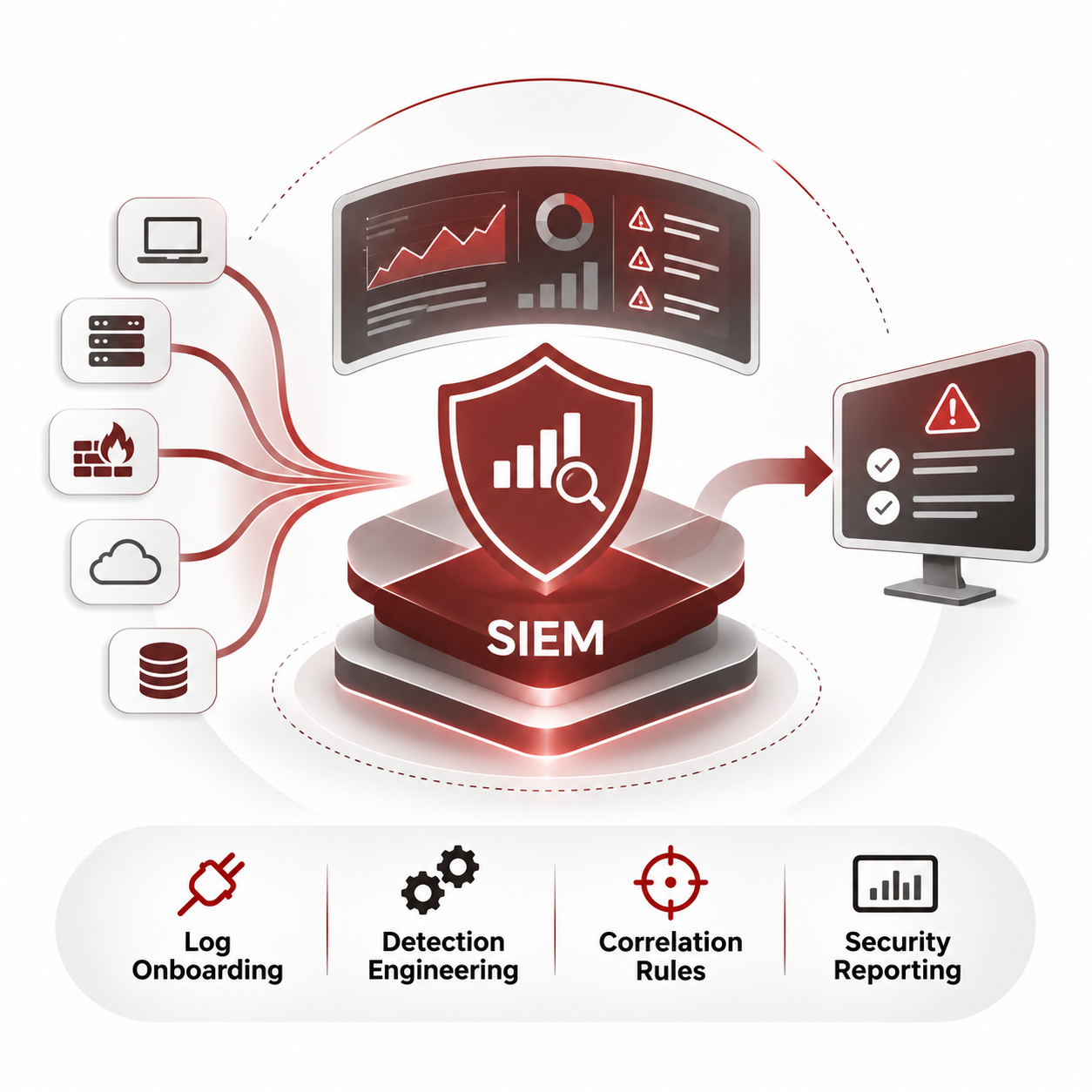
Managed SIEM & Log Management
Managed SIEM services support the collection and analysis of security logs from approved sources. Varutra can work with platforms such as Splunk, IBM QRadar, Wazuh and EaglEye, or help scope a customised SIEM architecture. Activities can include source onboarding, parsing validation, correlation logic, detection use cases, alert tuning, platform health review and dashboards. Log retention, access permissions and data handling are defined during service design.
- Onboarding of approved log sources and connectors
- Parsing, timestamp and ingestion validation
- Correlation rules and risk-based detection use cases
- Alert tuning and review of false-positive patterns
- Dashboards and agreed operational reporting
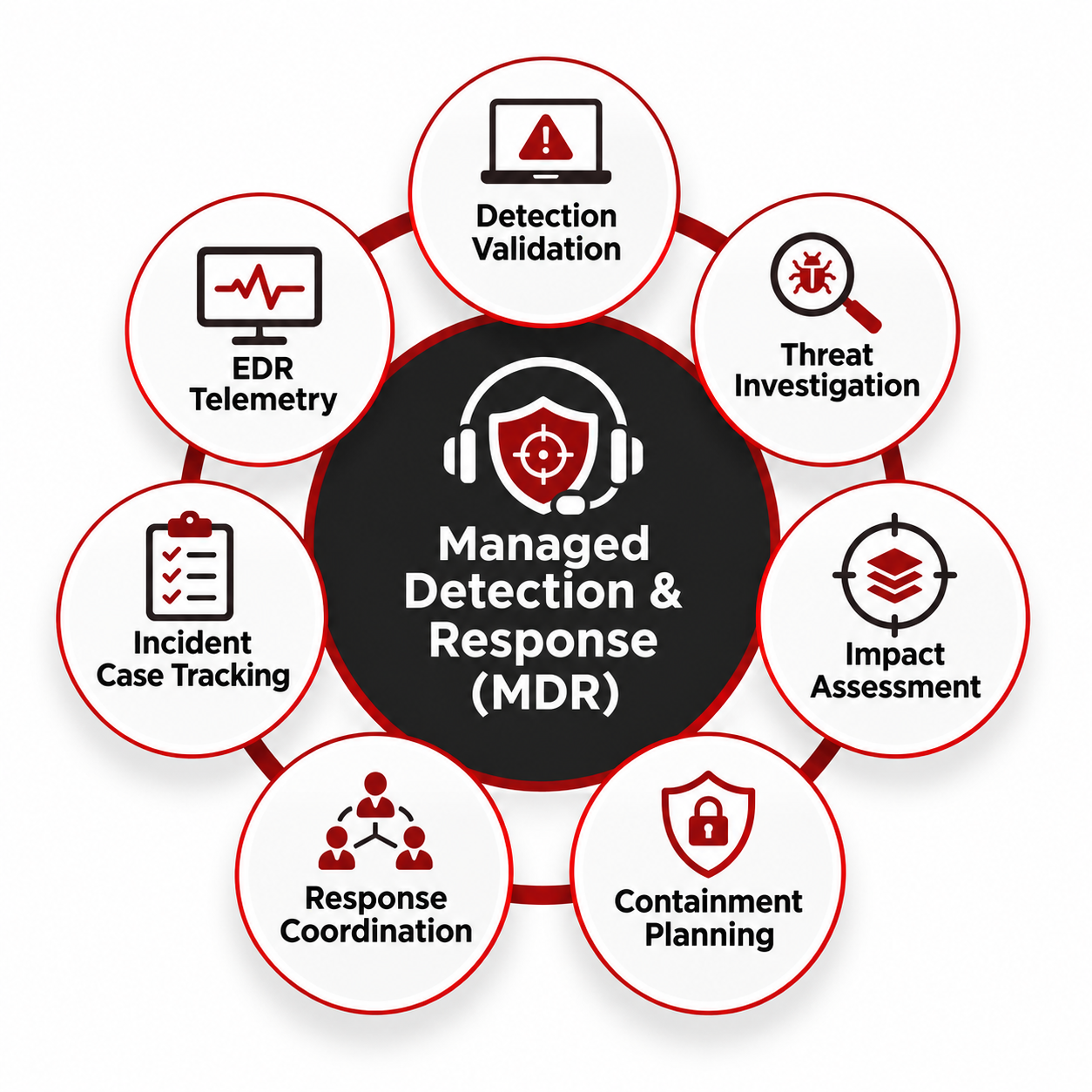
Managed Detection & Response (MDR)
Managed Detection and Response (MDR) adds investigation and response coordination to security detection. Analysts assess alert context, investigate suspicious endpoint or identity activity and recommend containment steps. Any direct action on customer systems must be explicitly authorised and supported by the agreed tools and runbooks.
- Detection validation and investigation of suspicious activity
- Endpoint, identity and network alert analysis
- Assessment of scope, impact and affected assets
- Containment recommendations or authorised actions
- Response coordination and incident case tracking
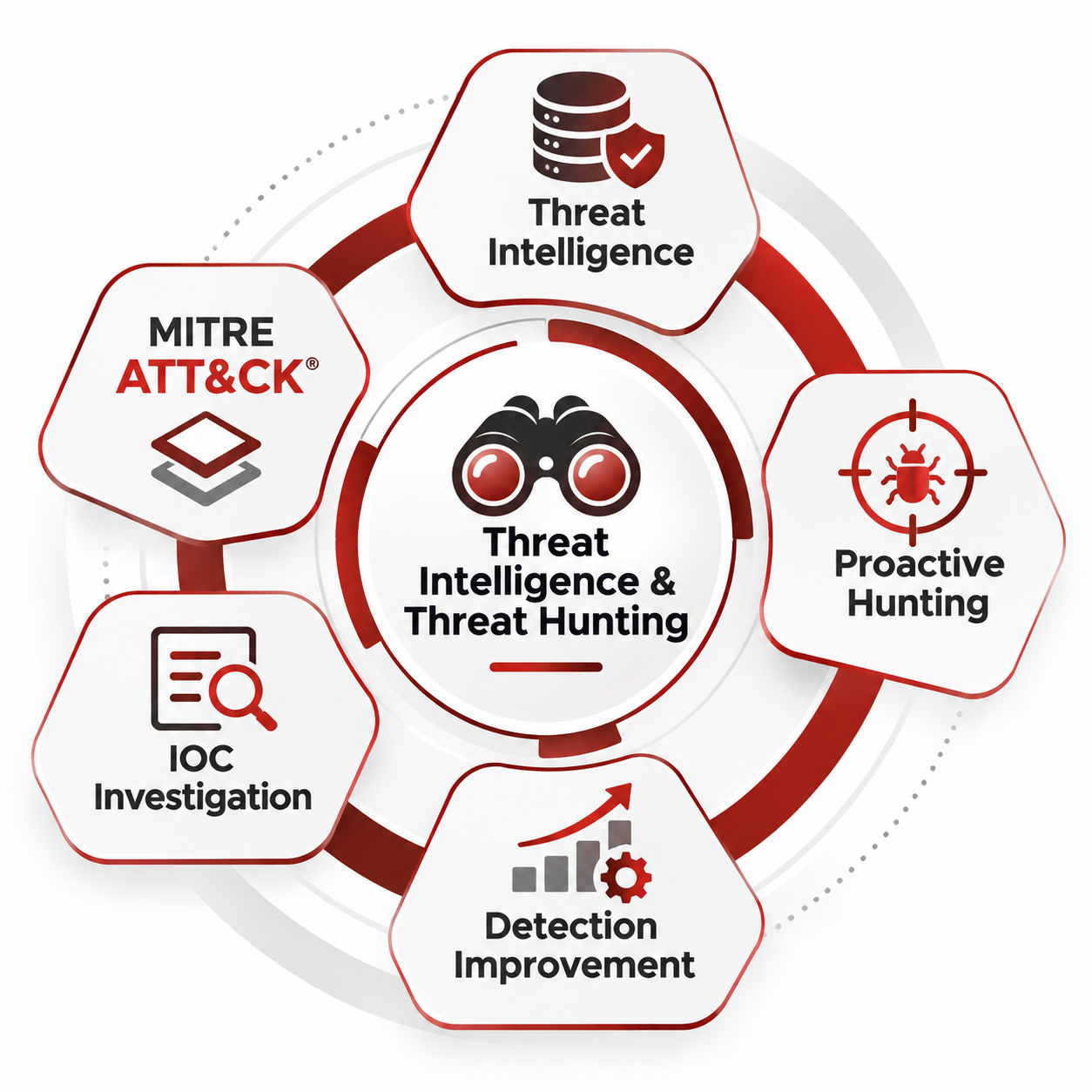
Threat Intelligence & Threat Hunting
Threat intelligence and hunting help examine activity that may not trigger an existing alert. Hunting hypotheses can be informed by relevant indicators, attacker behaviours and MITRE ATT&CK techniques. Findings are documented with supporting evidence, confidence, affected assets and recommendations for improving detection coverage.
- Threat intelligence enrichment where sources are available
- Hypothesis-led searches across collected telemetry
- Review of attacker tactics, techniques and procedures
- Investigation of indicators and suspicious patterns
- Detection gaps and prioritised improvement recommendations
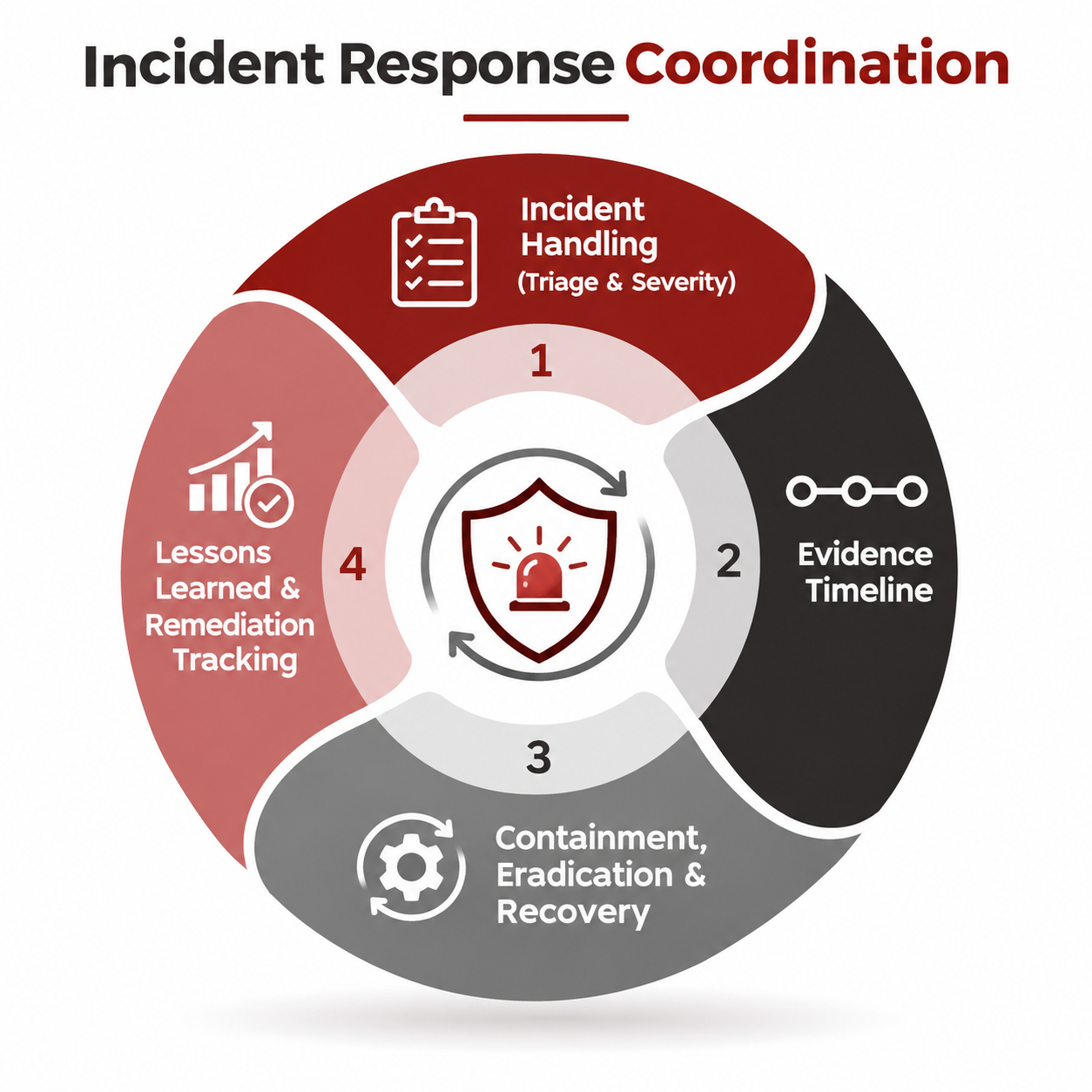
Incident Response Coordination
Incident response support helps internal teams understand an event, establish a timeline and coordinate containment, eradication and recovery activities. The agreed model may include incident validation, evidence preservation guidance, stakeholder escalation, remediation tracking and post-incident review. Legal notification decisions remain with the organisation.
- Incident triage, classification and severity assessment
- Event timeline development and investigation support
- Evidence preservation and stakeholder coordination
- Containment and recovery recommendations
- Post-incident findings and tracked corrective actions
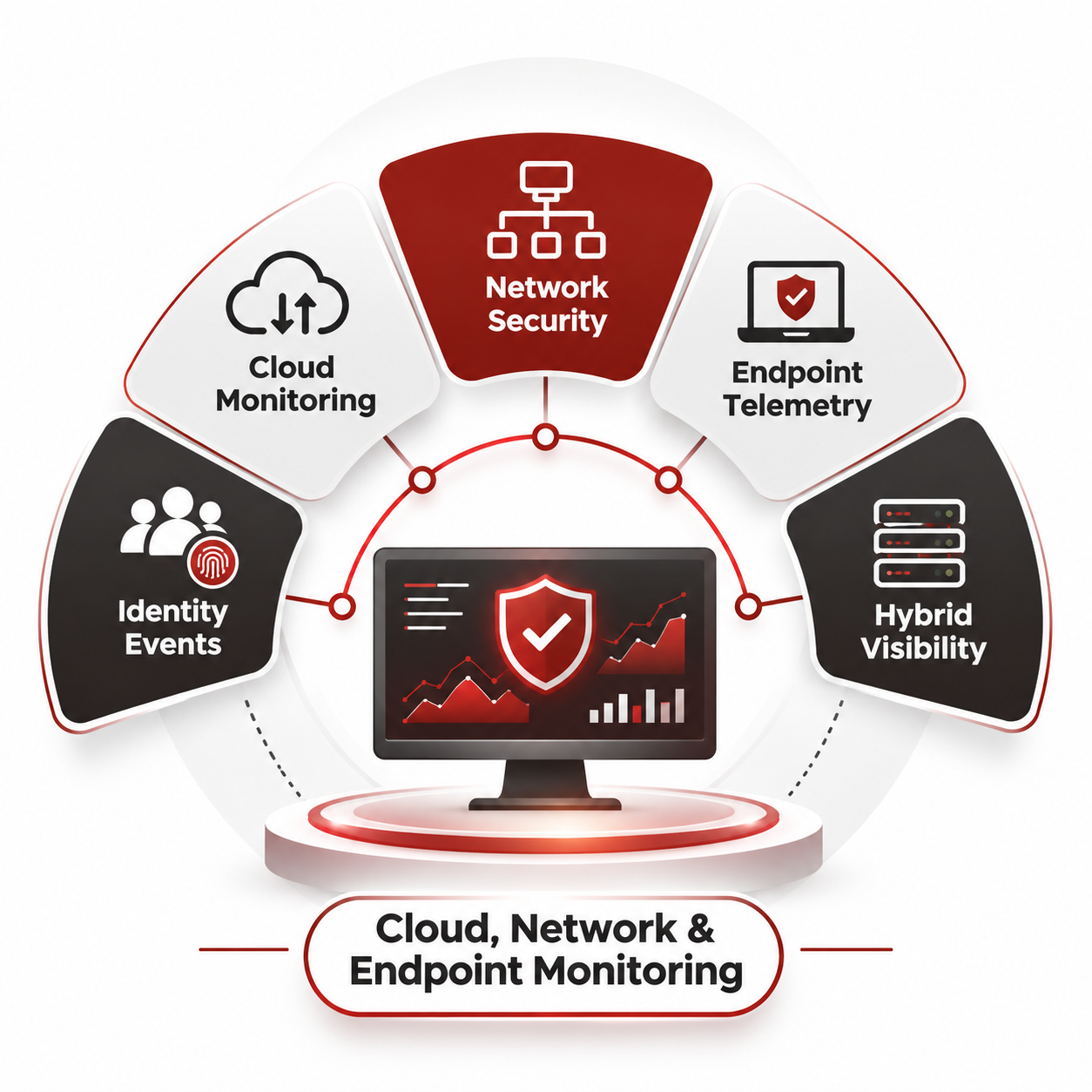
Cloud, Network & Endpoint Monitoring
Monitoring can combine telemetry from firewalls, VPNs, endpoints, servers, cloud platforms and identity services. Cross-source correlation can provide context for investigations, subject to available connectors, access rights, platform compatibility and the quality of the data supplied.
- Firewall, IDS/IPS, VPN and network event review
- Endpoint and server security telemetry
- Cloud audit events and workload alerts
- Identity, access and privileged activity monitoring
- Cross-environment correlation and escalation
SIEM Solutions for Unified Security Visibility
Choose a SIEM platform that fits your environment-or build a customised SIEM solution around your security architecture. Varutra offers SIEM implementation and integration options across Splunk, IBM QRadar, Wazuh and EaglEye, with support for log onboarding, use-case development, alert correlation, dashboards and ongoing optimisation.
Splunk SIEM
Centralise and search machine data, analyse security events and develop detection and investigation workflows using Splunk. Varutra can support deployment planning, data onboarding, correlation searches, dashboards and SIEM operations based on your licensed environment.
IBM QRadar
Use IBM QRadar to bring security events and flow data into a central analytics environment. SIEM implementation can include supported log-source integration, rule and offense tuning, use-case alignment and operational reporting.
Wazuh SIEM & XDR
Wazuh provides an open-source security monitoring platform for endpoint visibility, log analysis, threat detection and security configuration monitoring. Varutra can help design and configure Wazuh deployments, onboard supported sources and tune alerts for your environment.
EaglEye CyberFusion
EaglEye CyberFusion brings together SIEM, UEBA, SOAR, threat intelligence, network detection, asset discovery and cloud posture capabilities on a unified data model. The EaglEye Managed SOC datasheet describes L1–L3 analyst workflows, automated triage and investigation-led escalation.
Custom SIEM Solutions Designed Around Your Security Operations
Not every organisation needs the same SIEM architecture. Varutra can help design a tailored SIEM solution using suitable commercial or open-source technologies, integrate your existing security stack and configure detection content around your assets, risks and operational workflows.
Discuss a Custom SIEM SolutionPlatform capabilities, licensing, connectors and service scope vary by product and deployment. Final integrations and deliverables are confirmed during technical discovery.
EaglEye Managed SOC: Security Operations Built Around Your Environment
EaglEye Managed SOC (M-SOC) combines the EaglEye CyberFusion Platform with specialist security operations to support continuous monitoring, investigation and coordinated response. It is designed for organisations that need structured SOC operations without having to build every platform capability and analyst function in-house.
One operational view across security signals.
The platform brings together SIEM, user and entity behaviour analytics (UEBA), SOAR, threat intelligence, network detection (NDR), asset discovery through RADAR and cloud security posture management (CSPM) on a common data model. Existing security tools can feed the platform, helping teams investigate activity across connected sources instead of working through disconnected alerts.
Automated triage and validation
Event correlation, enrichment, MITRE ATT&CK mapping and AI-assisted verdicts help prioritise alerts. Analysts validate findings and escalate suspicious activity for deeper review.
Investigation and response
Analysts reconstruct incident timelines, connect related users, hosts and indicators, assess impact and coordinate response playbooks in line with agreed approval rules.
Threat hunting and escalation
Specialists conduct hypothesis-led hunting, refine detection logic, investigate complex activity and support escalation to incident response and forensic investigation specialists.
Deployment and data control
- On-premises, private cloud, hybrid or air-gapped deployment options
- Customer-controlled data retention and residency
- Native multi-tenancy with tenant isolation and role-based access controls
- Integration with supported network, endpoint, identity, cloud and application sources
Operational visibility and response
- Incident records with timelines, indicators and investigation context
- Daily and weekly digests, monthly security posture and executive reporting
- Audit trails for alerts, analyst actions and approvals
- Optional EaglEye Vanguard EDR actions, subject to integration and customer approval
Considering EaglEye for your SOC? Discuss your log sources, deployment preferences, retention needs and incident workflows to understand whether EaglEye Managed SOC is a fit for your environment.
Discuss EaglEye SOCEaglEye Managed SOC is described in the EaglEye service datasheet as a service delivered by Forensic CyberTech analysts on the EaglEye CyberFusion Platform. Platform specifications and service scope are subject to deployment design and engagement confirmation. Response actions that may disrupt customer systems follow agreed approval rules.
How Our Managed SOC Engagement Works
A well-scoped SOC engagement starts with the organisation’s critical services and risk priorities. Discovery establishes which events can be collected, who owns incident decisions and how monitoring, escalation and reporting will work in day-to-day operations.
Select or hover over each stage to explore the process
Map the systems that matter most, the people responsible for them and the events needed to identify relevant threats. Confirm what is in scope and where the customer retains operational ownership.
- Critical asset and business-service inventory
- Log-source and telemetry review
- Named owners and escalation matrix
Connect approved telemetry from SIEM, endpoint, network, identity and cloud sources. Validate that events arrive with the fields, timestamps and context needed for useful investigation.
- Connector and access validation
- Parsing, timestamp and source-health checks
- Coverage gaps and integration dependencies
Configure and tune detection use cases around business risk, known threat scenarios and the quality of available data. Agree severity levels and escalation criteria before live operations.
- Detection logic and correlation rules
- Severity and priority definitions
- Initial tuning and noise review
Review incoming alerts, enrich relevant events and correlate activity across connected sources. Record the analyst assessment and route incidents according to agreed priorities and coverage.
- Alert review and contextual enrichment
- Analyst triage and investigation notes
- Escalation against agreed service coverage
Investigate validated incidents and coordinate with the customer’s incident owner. Containment or remediation on customer systems is performed only where expressly authorised and technically enabled.
- Incident analysis and evidence timeline
- Customer and stakeholder notification
- Pre-authorised response actions, where agreed
Review incidents, alert patterns, service metrics and open recommendations. Use service reviews to prioritise tuning, improve telemetry coverage and track actions to completion.
- Incident and alert summaries
- Service performance and trend review
- Detection improvements and action tracking
SOC Operations Aligned to Recognised Frameworks
Frameworks provide useful reference points for organising detection, investigation and governance. Varutra can discuss relevant mappings within the agreed service scope; using a framework does not certify an organisation or guarantee regulatory compliance.
MITRE ATT&CK
Use the MITRE ATT&CK knowledge base to describe adversary tactics and techniques, develop hunting hypotheses and identify opportunities to improve detection coverage.
Explore frameworkNIST Cybersecurity Framework 2.0
The NIST CSF 2.0 functions-Govern, Identify, Protect, Detect, Respond and Recover-can help place SOC activities within the organisation’s wider cybersecurity risk programme.
Explore frameworkNIST SP 800-61
NIST incident response guidance can inform preparation, detection, analysis, containment, recovery and post-incident learning, adapted to the organisation’s incident management process.
Explore publicationISO/IEC 27001
Relevant ISO/IEC 27001 controls can help organisations consider monitoring, event review, incident management and evidence within their information security management system.
Explore standardCERT-In Directions
CERT-In directions and applicable sector-regulator requirements should be assessed by each organisation. SOC workflows can support detection, evidence capture and escalation but do not transfer statutory accountability.
Visit CERT-InClear Outputs for Security & IT Teams
Operational reporting should explain what happened, what was investigated, why it matters and which decisions or actions remain outstanding. The reporting format and cadence are agreed during service design.
What Useful SOC Reporting Should Explain
Give security leaders and IT owners a clear view of significant events, recurring patterns, detection coverage and the status of remediation-not just a count of alerts.
Discuss Reporting RequirementsExecutive SOC Overview
Summarise monitored activity, priority incidents, material trends and items requiring management attention.
Security Alert & Incident Register
Record event details, triage decisions, severity, assigned owner, escalation and current status.
Detection Coverage Review
Review which log sources and detection scenarios are covered, where visibility is limited and which tuning changes are recommended.
Incident Investigation Record
Capture investigation context, key timestamps, affected assets, findings and response actions agreed with the customer.
Service Performance & Trends
Track agreed operational indicators such as alert volumes, investigation queues, escalation status and response workflow progress.
Recommendations & Action Log
List prioritised improvements, responsible owners, dependencies and follow-up dates from service reviews.
A Practical Approach to Managed Security Operations
The value of a SOC depends on whether monitoring is connected to business risk and leads to clear decisions. Varutra’s engagement approach starts with scope, telemetry, responsibilities and the customer’s existing security operations-not a generic promise of protection.
Risk-Aligned Monitoring
Prioritise monitoring for critical applications, business services, privileged accounts and infrastructure based on risk and operational impact.
Connected Security Telemetry
Bring relevant endpoint, network, identity, server and cloud events into a consistent investigation workflow where integrations permit.
Analyst-Led Alert Triage
Assess alerts using available context, correlate related events and document why an issue is escalated or closed.
Defined Escalation & Runbooks
Agree severity definitions, named contacts, communication channels, approval steps and response authority before service activation.
Actionable Reporting
Provide reports that distinguish observed events, analyst findings, customer decisions and actions still in progress.
Fit With Your Existing Stack
Plan integrations around the organisation’s existing SIEM, EDR, firewall and cloud platforms, subject to compatibility, licensing and access.
Managed SOC Support for Security & Compliance Programs
A managed SOC can help an organisation detect events, preserve relevant records and route incidents to the right internal owners. It does not make an organisation compliant or replace its legal and regulatory responsibilities. Applicability depends on the entity, sector, systems and current regulatory directions; obtain qualified advice for reporting decisions.
Managed SOC & MDR: A Strategic Guide to 24/7 Cybersecurity Operations
Explore practical considerations for managed SOC services in India, from 24/7 security monitoring and SIEM operations to incident response and regulatory requirements.
- Choosing a managed SOC provider in India.
- Understanding SOC as a Service, SIEM and MDR.
- Planning 24/7 monitoring across cloud, network and endpoints.
- Understanding CERT-In incident reporting and log-retention considerations.
- Mapping SOC operations to relevant RBI, SEBI, DPDP and ISO 27001 requirements.
- Defining alert triage, escalation and incident response workflows.

Frequently Asked Questions
Find answers about managed SOC services in India, 24/7 monitoring, Splunk, IBM QRadar, Wazuh, EaglEye, custom SIEM solutions, MDR and onboarding.
A managed SOC service provides agreed security monitoring and operational support through an external team. Depending on scope, it can include log monitoring, SIEM operations, alert triage, threat hunting, investigation, incident coordination and reporting across connected systems.
Security events from approved log sources and security tools are collected and analysed against configured detection rules. Analysts review relevant alerts, assess context and escalate validated concerns to designated contacts according to the contracted coverage and service levels.
SOC as a Service generally describes outsourced security monitoring and operations. MDR places greater emphasis on investigating detected threats and coordinating or carrying out authorised response actions. The exact boundary depends on the service agreement.
Integration may be possible where connectors, licences, access rights and telemetry are supported. Discovery should confirm the products in use, log volume, data quality, integration effort and any coverage limitations.
A SOC workflow can help identify and record event timelines, preserve available evidence and notify the organisation’s incident owners. The organisation must determine whether an incident is reportable and meet the applicable CERT-In reporting requirement.
Pricing is usually shaped by monitored assets, log sources and ingestion, SIEM licensing, coverage hours, detection complexity, retention, reporting, response permissions and onboarding effort. A scoped assessment is needed for a meaningful estimate.
Yes, where the relevant cloud, network, endpoint and on-premises logs can be securely integrated and monitored. Discovery should identify accounts, systems, identity sources, ownership and any telemetry gaps.
Varutra offers SIEM solution options including Splunk, IBM QRadar, Wazuh and EaglEye, alongside custom SIEM design, integration and managed SIEM services. Product selection and scope depend on your infrastructure, security requirements, licensing, log sources and operational needs.
Yes. Varutra can help assess SIEM requirements and plan a customised solution covering platform selection, log-source onboarding, integrations, parsing, correlation rules, dashboards, alert workflows and ongoing tuning. The final design is scoped to your environment and requirements.
Strengthen Your Security Operations With Managed SOC Services
Share your critical systems, existing SIEM platform, security controls and incident escalation expectations with Varutra. We can help identify monitoring priorities, compare SIEM options, assess integration dependencies and define a practical scope for managed SOC and customised SIEM services in India.


