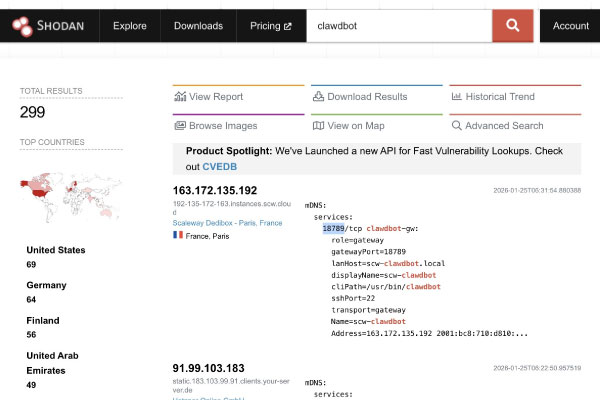
A widespread misconfiguration in the AI utility Clawdbot has resulted in thousands of deployed instances being inadvertently exposed to the public internet. The core issue originates from a localhost-based authentication trust model intended for development environments. Under default settings, Clawdbot implicitly trusts any request appearing to originate from 127.0.0.1, allowing privileged access without requiring authentication. While convenient for local testing, this design assumption becomes dangerous when such instances are deployed in production environments without additional hardening, effectively turning internal trust logic into an external attack surface. Clawdbot is commonly deployed by individuals and enterprises on Mac mini systems, containerized environments, and virtual private servers. In many real-world setups, these deployments are placed behind reverse proxies such as NGINX or Caddy to expose web interfaces externally. However, when a reverse proxy forwards requests to the backend application, the source IP often appears as 127.0.0.1. Because Clawdbot fails to validate the original client address or enforce proxy-aware authentication controls, external traffic is mistakenly treated as trusted local traffic. This architectural oversight allows unauthenticated attackers to access administrative APIs, agent controls, and internal functionality that should otherwise be restricted. The security implications of this exposure are significant. Many Clawdbot instances operate with elevated permissions and have access to sensitive telemetry, environment variables, API tokens, and third-party service credentials. An attacker exploiting this authentication bypass could execute arbitrary commands, manipulate agent behavior through prompt injection, or exfiltrate confidential data from connected systems. Following disclosure, community contributors introduced patches to tighten default authentication behavior and improve handling of proxied requests. Additionally, Clawdbot’s documentation has been updated to emphasize secure deployment practices, including explicit authentication enforcement and careful reverse-proxy configuration, to prevent similar exposures in production environments.
Security researchers have uncovered a sophisticated phishing campaign targeting TRON wallet users through a malicious Chrome extension impersonating the popular TronLink wallet. Th...
Online shoppers are facing a renewed threat as cybercriminals linked to the Magecart ecosystem have begun abusing Google Tag Manager (GTM) containers to distribute malicious credit...
A serious security flaw has been discovered in the Cline kanban package that could allow attackers to perform remote code execution, steal sensitive data, and stop active AI sessio...