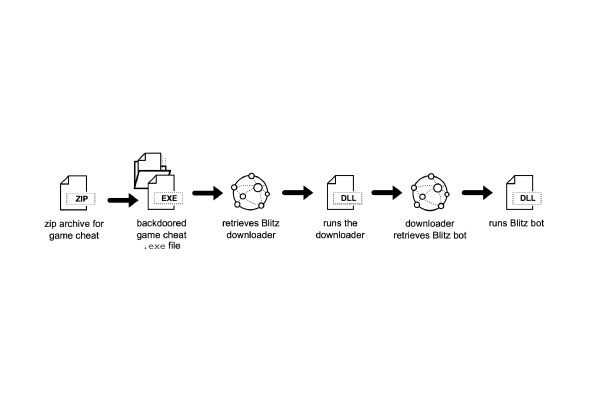
Unit 42, Palo Alto Networks' threat intelligence unit, exposed a malicious campaign centered on Blitz malware that targets gamers seeking cheats for the mobile game Standoff 2. The campaign lured users through Telegram by distributing backdoored cheat files like Nerest_CrackBy@sw1zzx_dev.zip and Elysium_CrackBy@sw1zzx_dev.zip, which contained trojanized Windows executables. After release, the malware conducted a two-part attack: a downloader downloaded the second payload from Hugging Face Spaces, and then injected the Blitz bot into RuntimeBroker.exe. The bot executed numerous illicit activities such as keylogging, screenshotting, cryptojacking with XMRig, and DDoS attacks. The malware campaign distributed mostly via Telegram, where the actor "sw1zzx" promoted the cheats through Cyrillic-language posts. Blitz malware evaded detection using sophisticated anti-sandboxing techniques and leveraged legitimate platforms like Hugging Face Spaces to host and control its distribution. Through April 2025, there were 289 infections in 26 countries with Russia, Ukraine, Belarus, and Kazakhstan being the most impacted. A goodbye note and a claimed "cleaner.exe" utility were subsequently published by the author, though analysts believe this was a ruse, as the cleaner did not work to eliminate the malware completely because of a registry typo. Users should not download game cheats or cracked applications from unknown sites since these are frequently used by cybercriminals for exploitations. Organizations need to implement endpoint protection, phishing/social engineering risk education for users, and inspect network traffic for abnormal behavior. Developers and platform providers need to enhance surveillance in order to avoid misuse of trusted infrastructure for malware propagation.
The Wireshark Foundation has released version 4.6.5 of Wireshark to address a significant number of security vulnerabilities impacting its widely used network analysis tool. This u...
When a new asset goes live on the internet, it becomes visible almost immediately to automated scanning systems. Within minutes, tools continuously sweeping the internet detect the...
Security researchers have identified a sophisticated Python-based backdoor framework known as DEEP#DOOR, engineered to provide attackers with long-term, covert access to compromise...